Have you ever walked on lava fields older than time itself, or stood face to face with creatures found nowhere else on Earth? The Galápagos Islands aren’t just a destination—they’re a living testament to nature’s raw creativity. From volcanic craters to alien-like landscapes, every step feels like a journey back to the planet’s beginnings. This is exploration at its purest. Millions of years in the making, shaped by fire and isolation, the archipelago offers a rare window into how life adapts, survives, and thrives in extreme conditions. For travelers seeking both adventure and meaning, the Galápagos stand apart—not only for their beauty but for the deep story they tell about our planet’s past, present, and future.
The First Glimpse: Arriving in a Primal World
Touching down on Baltra Island, visitors are immediately immersed in a world that defies tropical expectations. Instead of dense palm forests and soft white sands, the landscape unfolds in shades of rust, charcoal, and dusty green. The air carries a dry warmth, scented faintly of salt and volcanic minerals. This is not a manicured paradise but a rugged, untamed ecosystem shaped by millennia of geological upheaval and oceanic solitude. The Galápagos, located nearly 1,000 kilometers off the coast of Ecuador, rise from the Pacific like sentinels of natural history. Their isolation has allowed evolution to unfold in unique ways, undisturbed by human influence for most of their existence.
What sets the Galápagos apart begins with its silence—no rustling of small mammals, no chirping insects—but the occasional grunt of a sea lion or the sharp cry of a frigatebird overhead. Wildlife here shows no fear, a result of evolving without natural predators. Iguanas sunbathe inches from walking paths; blue-footed boobies nest beside trails; marine turtles glide past snorkelers as if they belong to the same world. This seamless coexistence between observer and observed creates an intimate experience unlike any other on Earth. The moment travelers realize they are guests in a self-sustaining theater of life, a profound shift occurs—one of humility and awe.
The archipelago consists of 18 main islands and numerous islets, formed by ongoing volcanic activity along the Nazca Plate. Many of the islands are geologically young, with some still actively growing. Isabela, the largest, was created by the merging of six shield volcanoes, three of which remain active. This youth means the terrain is raw and unrefined—jagged lava flows, cinder cones, and barren highlands dominate. Yet within this harshness lies extraordinary biodiversity. Over 9,000 species inhabit the islands, nearly half of which are endemic. The conditions that once inspired Charles Darwin’s theory of evolution continue to offer scientists and travelers alike a front-row seat to nature’s adaptability.
Walking on Fire: The Volcanic Backbone of the Islands
Beneath the surface of the Galápagos lies a restless force—the Galápagos hotspot, a plume of molten rock rising from deep within the Earth’s mantle. As the Nazca Plate moves eastward, this hotspot continuously erupts, forming new islands while older ones erode and subside. The result is a dynamic chain where fire shapes land in real time. Sierra Negra, on Isabela Island, hosts one of the most active volcanoes in the region, with a caldera spanning over nine kilometers—among the largest in the world. Its last major eruption in 2018 sent rivers of lava flowing across the landscape, reshaping trails and altering habitats.
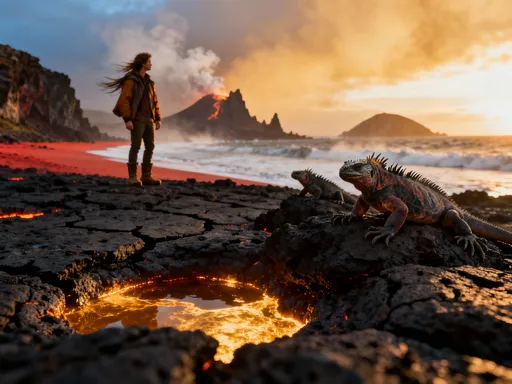
Hiking across these volcanic formations offers an almost surreal experience. The pahoehoe lava, smooth and ropy in texture, glistens under the equatorial sun like frozen waves. In contrast, ‘a‘ā lava forms jagged, clinkery fields that crunch underfoot, a reminder of the violent forces that forged them. Trails wind through lava tubes, collapsed craters, and fumaroles where steam still escapes from deep below. The ground itself feels alive—warm in places, unstable in others. Yet life persists even here. Pioneer species like lichens and lava cacti begin the slow process of colonization, breaking down rock into soil over centuries.
These volcanic landscapes are not static relics but living, evolving features. New eruptions add landmass, while erosion carves it away. Fernandina Island, one of the youngest, experiences frequent lava flows that extend its coastline. Each event resets the ecological clock, allowing scientists to study succession—the gradual return of vegetation and animal life—in real time. For visitors, walking on terrain that may not have existed a decade ago underscores the impermanence and resilience of nature. It’s a humbling reminder that the Earth is not a fixed entity but a dynamic system in constant transformation.
Lava Tunnels and Crater Lakes: Nature’s Hidden Architecture
Beneath the sun-baked surface of the Galápagos lies a hidden world—networks of lava tunnels formed when molten rock flowed beneath a hardened crust. As the lava drained, it left behind vast, cathedral-like passages, some stretching hundreds of meters through solid rock. These tunnels, cool and dimly lit, offer a striking contrast to the arid exterior. Guided tours allow visitors to walk through these natural wonders, their walls etched with flow marks and stalactite-like formations. The silence inside is profound, broken only by the occasional drip of condensation or the flutter of a lava lizard darting across the floor.
One of the most accessible lava tunnels is located near Santa Cruz Island, where a well-maintained path leads into a 500-meter-long tube. The temperature drops significantly inside, offering relief from the midday heat. The ceiling, pockmarked and textured, glows faintly when illuminated, revealing the fluid motion that once shaped it. These tunnels are not just geological curiosities—they serve as shelters for endemic species, including the Galápagos snake and various bat populations. Some even contain small pools of freshwater, rare in an environment where rainfall is limited and evaporation high.
In contrast to the subterranean fire-born structures, the highlands host another kind of geological marvel—crater lakes. El Junco, perched on the summit of San Cristóbal Island, fills a dormant volcanic crater with cool, still water. Mist often hovers above its surface, creating an ethereal atmosphere. This rare permanent freshwater lake supports a variety of birdlife, including the elusive Galápagos rail and numerous migratory species. Surrounded by lush vegetation, it stands in stark contrast to the arid lowlands, illustrating how elevation and microclimates shape the islands’ ecology.
Together, these features reveal a duality inherent in the Galápagos: fire below, life above. The same forces that destroy also create. Lava flows obliterate existing habitats, yet they lay the foundation for new ones. Crater lakes form in the aftermath of eruptions, becoming oases in otherwise dry landscapes. This interplay between destruction and renewal is central to understanding the archipelago’s resilience. For travelers, exploring both the underground tunnels and the highland lakes offers a fuller picture of the islands’ complexity—a journey from the Earth’s fiery core to its life-sustaining surface.
Scalesia Forests and Mangrove Labyrinths: Life Taking Root
Despite their volcanic origins, the Galápagos are not barren wastelands. In the humid highlands of islands like Santa Cruz and San Cristóbal, dense Scalesia forests thrive. These trees, part of the daisy family, grow up to 20 meters tall, forming a green canopy that drips with moss and epiphytes. Often called “Darwin’s orchid trees” due to their delicate flowers, Scalesia forests are unique to the archipelago and represent one of the few true cloud forest ecosystems in the region. Walking through them feels like stepping into another world—cool, damp, and teeming with life.
These forests are home to a rich array of bird species, including the vermilion flycatcher and the Galápagos mockingbird. Insects buzz among the leaves, and land snails cling to tree trunks, thriving in the moisture-rich environment. Unfortunately, Scalesia forests are under threat from invasive species such as blackberry and guava, which outcompete native plants for resources. Conservation efforts are underway to restore these areas, with local organizations and park rangers working to remove non-native vegetation and replant endemic species. For visitors, guided walks through protected zones offer a chance to witness both the beauty and fragility of these ecosystems.
Along the coast, another vital habitat thrives—mangrove forests. These salt-tolerant trees take root in tidal zones, their tangled roots forming intricate labyrinths that shelter juvenile fish, crabs, and even sea turtles. Four species of mangroves exist in the Galápagos, each adapted to slightly different conditions. Red mangroves, with their stilt-like prop roots, dominate sheltered bays, while black and white mangroves occupy higher ground. These forests serve as nurseries for marine life, filtering pollutants and stabilizing shorelines against erosion.
Snorkeling or kayaking through mangrove channels reveals a hidden dimension of island life. Brightly colored Sally Lightfoot crabs scuttle across roots, while herons and egrets stalk the shallows. Schools of golden mojarras dart between submerged branches, safe from larger predators. These ecosystems are particularly vulnerable to climate change and human activity, making their protection essential. By preserving mangroves and Scalesia forests, the Galápagos National Park ensures that both terrestrial and marine biodiversity continue to flourish.
Otherworldly Shores: Beaches of Green, Black, and Red
Some of the most unforgettable moments in the Galápagos happen at the water’s edge. The archipelago’s beaches are unlike any others on Earth, colored not by quartz but by volcanic minerals and marine deposits. At Punta Cormorant on Floreana Island, a beach glistens with fine green olivine crystals, remnants of ancient eruptions. This rare gemstone, formed deep within the Earth’s mantle, is brought to the surface by volcanic activity and slowly ground into sand by wave action. Walking on it feels like treading on stardust—a surreal, almost magical experience.
Just a short distance away lies a contrasting shoreline—a beach of powdery white coral sand, one of the few in the Galápagos. This duality, green and white, side by side, illustrates the islands’ geological diversity. The green olivine beach is not open for swimming due to its ecological sensitivity, but visitors can observe flamingos wading in a nearby lagoon, their pink feathers glowing against the muted backdrop. This careful balance—allowing access while protecting fragile habitats—defines the Galápagos approach to tourism.
Other beaches display hues of crimson and black. On Santiago Island, Puerto Egas offers a jet-black shore formed from basaltic lava, its surface smooth and reflective after rain. Nearby, beaches tinted red by pulverized coral and shells create a dramatic contrast against turquoise waters. These colors are not just aesthetic—they are direct indicators of the islands’ volcanic chemistry and marine productivity. The presence of olivine suggests mantle-derived magma, while red sands point to rich coral ecosystems offshore.
Each beach tells a story of geological and biological interplay. The black sands absorb heat, warming the nesting grounds of sea turtles and marine iguanas. The green olivine beaches, though too soft for nesting, attract curious travelers and photographers. And the white coral sands provide calm waters ideal for snorkeling with sea lions and reef fish. By understanding the origins of these shores, visitors gain deeper appreciation for the forces that shape them—not just as scenic backdrops but as active components of the island’s ecology.
Choosing Your Path: Matching Landscapes to Your Exploration Style
With 19 major islands and over 100 visitor sites, planning a trip to the Galápagos can feel overwhelming. The key is aligning personal interests with the unique offerings of each island. Adventurers seeking dramatic terrain and challenging hikes will find Isabela Island unparalleled. Home to five of the archipelago’s six active volcanoes, it offers treks across lava fields, summit climbs, and encounters with giant tortoises in the wild. The trail to Sierra Negra’s caldera, for example, spans several kilometers and rewards hikers with panoramic views of the vast crater and surrounding islands.
For those drawn to birdlife and coastal drama, Española Island delivers. Located at the southeastern edge of the archipelago, it hosts one of the most diverse seabird colonies in the Galápagos. Visitors can watch albatrosses perform courtship dances, blue-footed boobies plunge-dive into the sea, and waved albatrosses—found nowhere else—soar above cliff edges. The island’s rugged coastline, shaped by centuries of wave erosion, features natural arches and blowholes that add to its wild beauty. Due to its remote location, access is limited, preserving its pristine condition.
Santa Cruz, the most visited island, offers a balanced experience. It serves as a gateway for many travelers, with access to the Charles Darwin Research Station, giant tortoise reserves, and both lava tunnels and highland farms. Families and first-time visitors appreciate its range of activities, from easy nature walks to snorkeling with penguins. At the same time, it remains a hub for scientific study and conservation, making it an ideal place to learn about ongoing efforts to protect the ecosystem.
Travel logistics are tightly regulated to minimize environmental impact. Visitors typically explore via certified cruise ships or day tours operated by licensed guides. Each site has specific rules—staying on marked trails, maintaining distance from wildlife, and avoiding littering. These guidelines ensure that tourism supports conservation rather than undermines it. By choosing itineraries that match their interests and physical abilities, travelers can have meaningful, low-impact experiences while contributing to the islands’ long-term preservation.
Traveling with Purpose: Preserving the Fragile Balance
The Galápagos Islands are among the most carefully managed protected areas in the world. With only 200,000 visitors allowed annually and strict biosecurity protocols in place, the Ecuadorian government and the Galápagos National Park Directorate have set a global standard for sustainable tourism. Every traveler must pass through quarantine upon arrival, where luggage is inspected for non-native seeds, insects, or food items that could disrupt the delicate ecological balance. This precaution is not symbolic—it is essential. Invasive species have already altered parts of the ecosystem, and vigilance remains critical.
Once on the islands, visitors are required to stay on designated paths and follow the guidance of certified naturalist guides. These professionals, trained in ecology and conservation, provide context and ensure compliance with park rules. They explain the significance of what travelers are seeing—not just the “what” but the “why.” A marine iguana basking on lava isn’t just a photo opportunity; it’s a species that evolved to swim and feed on algae in cold currents, a marvel of adaptation. Understanding this deepens respect and encourages responsible behavior.
Plastic waste is another major concern. Single-use plastics are banned in the archipelago, and visitors are encouraged to bring reusable bottles, bags, and containers. Many tour operators have adopted zero-waste policies, providing filtered water stations and compostable materials. These efforts are part of a broader initiative to reduce the human footprint and protect marine life, particularly sea turtles and seabirds that can mistake plastic for food.
Sustainable tourism in the Galápagos is not just about rules—it’s about mindset. Travelers are invited to see themselves not as conquerors of nature but as temporary stewards. Every decision, from where to step to what to photograph, carries weight. By embracing this responsibility, visitors become allies in conservation. Their fees support park maintenance, research, and community programs, creating a cycle of protection that benefits both nature and local residents.
More Than a Destination—A Lesson in Earth’s Story
The Galápagos do more than inspire wonder—they invite reflection. Each cracked lava field, each endemic finch singing in the highlands, each sea turtle gliding through kelp forests, tells a chapter in the long narrative of life on Earth. This is not a place to merely check off a bucket list but to slow down, observe, and connect with the fundamental processes that shape our planet. The islands remind us that evolution is not a distant theory but an ongoing reality, visible in the beak of a bird or the color of a beach.
For the thoughtful traveler, especially those who value family, nature, and meaningful experiences, the Galápagos offer something rare: a chance to witness the balance between destruction and creation, isolation and connection, fragility and resilience. It is a place where science and soul meet, where curiosity leads to understanding, and where exploration becomes a form of reverence.
By traveling wisely—respecting boundaries, supporting conservation, and sharing stories with care—visitors do more than enjoy a vacation. They participate in the protection of one of Earth’s most extraordinary places. The Galápagos are not just a destination. They are a legacy—a living classroom, a sanctuary of biodiversity, and a powerful reminder that we are part of a much larger story. And in that story, every step matters.