Sokcho is more than just mountain hikes and seafood markets. Tucked away from the crowds are quiet cultural spaces where tradition lives softly—in hanji workshops, forgotten temples, and local art corners. I stumbled on these spots by chance, and honestly? They changed how I see Korea. If you’re looking for soul over sightseeing, this is where Sokcho truly shines. Let me take you off the map to places most travelers never find.
Beyond the Brochure: Redefining Sokcho’s Cultural Identity
Sokcho, a coastal city nestled between the East Sea and the dramatic peaks of Seoraksan, often appears in travel guides as a destination of postcard-ready views and outdoor adventure. Visitors flock to hike the well-marked trails of Seoraksan National Park, stroll along Sokcho Beach, or savor fresh octopus at the bustling Donghae Market. These experiences are undeniably rewarding, but they represent only one layer of the city’s identity—one shaped by mass tourism and commercial visibility. Beneath this familiar surface lies a quieter, more intimate Sokcho, where culture is not performed for cameras but lived with quiet dignity.
What makes these hidden cultural spaces so meaningful is their authenticity. Unlike attractions designed for high visitor turnover, these places operate at the pace of tradition. They are sustained by individuals—artisans, monks, elders, artists—who carry forward practices that have shaped Korean life for generations. In an era when many historic customs are fading under the pressure of modernization, finding communities that still honor them becomes not just a travel curiosity, but an act of cultural connection. Seeking these experiences allows travelers to move beyond passive observation and into genuine understanding.
For the thoughtful traveler, especially those in their 30s to 50s who value depth and meaning in their journeys, Sokcho offers something rare: a chance to engage with Korea’s heritage in a personal, unhurried way. This isn’t about ticking off landmarks but about slowing down, listening, and noticing the subtle details—the curve of a hand-folded paper lantern, the echo of a temple bell at dawn, the quiet concentration of a weaver’s hands. These moments don’t shout for attention. They wait to be discovered by those willing to look beyond the obvious.
The Art of Hanji: A Paper-Making Studio Off the Beaten Path
One such discovery lies in a modest hanji workshop tucked into a quiet residential alley, far from the main tourist routes. Hanji, the traditional Korean paper made from the inner bark of mulberry trees, has been produced in Korea for over a thousand years. It is not merely paper; it is a cultural artifact—used historically for everything from royal documents and Buddhist scriptures to window coverings and clothing. Today, its production is a dwindling craft, preserved only by a handful of dedicated artisans, many of whom work in small, family-run studios like this one in Sokcho.
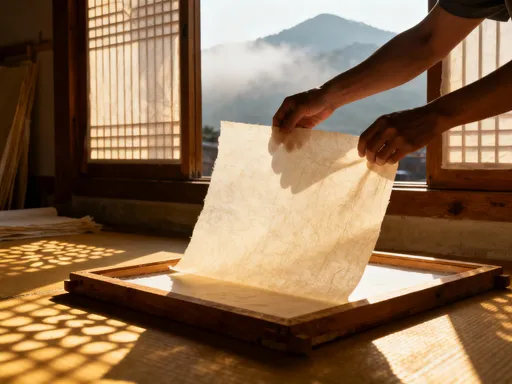
Inside the workshop, the air carries the earthy scent of soaked mulberry bark, mingling with the faint sweetness of natural dyes. The process begins with harvesting and steaming the bark, followed by meticulous hand-scraping to remove the outer layers. The inner fibers are then boiled, beaten into a pulp, and carefully laid onto bamboo screens using a unique technique called ‘momme’ that ensures even thickness and strength. Each sheet is formed by hand, pressed, and left to dry slowly in the mountain air. The result is a paper that is both durable and surprisingly soft—capable of lasting centuries, as proven by ancient manuscripts still intact in national archives.
What makes this experience so powerful is its sensory richness. Visitors are invited to touch the freshly made sheets, feel their texture, and watch the light filter through translucent layers. Some workshops even allow guests to try their hand at forming a small sheet, offering a rare hands-on connection to a centuries-old tradition. The owner, a woman in her late fifties who returned to Sokcho after decades in Seoul, speaks softly about her work not as a business but as a responsibility. “This paper held our history,” she says. “If we stop making it, we lose a part of who we are.”
Preserving hanji is not only a cultural imperative but also an environmental one. Unlike industrial paper, hanji is made without harsh chemicals and is fully biodegradable. Its production supports sustainable forestry and low-impact craftsmanship. By visiting such studios and supporting their work—whether through purchases or respectful engagement—travelers contribute to the survival of a tradition that embodies Korean values of patience, precision, and harmony with nature.
A Temple Stay Without the Crowds: Singwansa’s Quiet Wisdom
Just a short drive from the popular Baekdamsa Temple, tucked into a secluded valley along the same mountain route, lies Singwansa—a Buddhist temple that offers a profoundly different experience from its more famous neighbor. While Baekdamsa draws crowds, especially during peak seasons, Singwansa remains relatively unknown, visited mostly by local devotees and the occasional mindful traveler. Its wooden buildings, weathered by time and mountain mist, blend seamlessly into the forest, creating an atmosphere of stillness that feels almost sacred.
Founded over 1,300 years ago, Singwansa has long served as a place of meditation and spiritual retreat. Unlike temples that have been extensively renovated for tourism, Singwansa retains much of its original character—its prayer halls are simple, its paths lined with moss-covered stones, and its daily rituals conducted with quiet devotion. A brief visit, even without participating in an overnight temple stay, offers a rare opportunity to experience Buddhist practice in its most grounded form. The morning bell rings at 5:30 a.m., followed by chanting that drifts through the trees like a whisper. Incense smoke curls into the cool air, carrying with it a sense of timelessness.
What stands out is the emphasis on silence. Visitors are gently reminded to speak softly, move slowly, and observe with humility. There are no loud guides, no selfie sticks, no rush. Instead, there is space—to sit on a wooden bench and watch sunlight filter through cedar branches, to notice the way the wind moves the temple flags, to simply breathe. For many modern travelers, especially those juggling the demands of family and career, this kind of stillness is not just refreshing; it is restorative.
Respectful visitor etiquette is essential. Shoes must be removed before entering any hall, shoulders should be covered, and photography is limited to exterior spaces. These rules are not barriers but invitations—to slow down, to be present, to honor the space as more than a backdrop. For families traveling with older children or teens, a visit to Singwansa can be a gentle introduction to mindfulness, offering a contrast to the constant stimulation of daily life. It reminds us that travel can be not just about seeing, but about feeling, reflecting, and reconnecting.
Local Voices: Independent Galleries and Artist Studios
While Sokcho’s natural beauty draws many, it is also becoming a quiet hub for creative expression. Scattered through the city’s side streets and hillside neighborhoods are small galleries and artist studios, often run by individuals who have returned to their hometowns or moved from larger cities seeking inspiration. These spaces are not part of any official art district, nor are they heavily promoted. Instead, they thrive on word of mouth, local support, and the quiet rhythm of creative life.
What unites these artists is their deep connection to place. The coastal light—soft and silvery in the mornings, golden at dusk—shapes the palette of painters who capture the sea’s ever-changing moods. Sculptors draw from the textures of mountain stone and driftwood, while ceramicists use local clays to create pieces that echo the region’s geology. Some incorporate traditional motifs—clouds, cranes, waves—into contemporary designs, bridging past and present in subtle, meaningful ways.
One studio, located in a renovated hanok near the Sokcho River, hosts monthly open days where visitors can watch artists at work, sip locally grown tea, and engage in quiet conversation. There is no pressure to buy; the focus is on connection. Another space, run by a former Seoul-based illustrator, specializes in hand-printed journals covered in hanji and adorned with pressed mountain flowers. These pieces are not souvenirs in the commercial sense but keepsakes—objects imbued with care and intention.
Supporting these artists does more than preserve creativity; it sustains community-based tourism. When travelers choose to visit independent studios, they help keep cultural expression alive at the grassroots level. These spaces are often self-funded and operate on slim margins, making each visit meaningful. For the discerning traveler, engaging with local art is not just about acquiring something beautiful—it’s about participating in a story, supporting a livelihood, and carrying a piece of Sokcho’s soul home with them.
Seomjitgol Village: Where Folk Traditions Still Breathe
Along the banks of the Sokcho River, shaded by willow trees and bordered by stone walls, lies Seomjitgol Village—a neighborhood that feels suspended in time. Its narrow lanes wind between low wooden houses with tiled roofs, many of which have stood for generations. Unlike reconstructed heritage sites, Seomjitgol is a living community, where elders sit on sun-warmed steps, children play in shared courtyards, and the rhythm of life follows seasonal changes rather than tourist schedules.
The village has become a quiet focal point for cultural preservation. Local volunteers and a small community association have worked to maintain the traditional architecture, repair aging structures with authentic materials, and revive fading customs. Seasonal events—such as spring tea ceremonies, autumn weaving demonstrations, and winter lantern-making workshops—are held with minimal fanfare but deep sincerity. These are not performances for tourists but shared practices that reinforce community bonds.
Walking through Seomjitgol feels like stepping into a different Korea—one where life moves at the pace of nature, where craftsmanship is part of daily living, and where respect for ancestors is woven into everyday gestures. A grandmother might be seen folding paper charms for a household shrine, or a neighbor repairing a fishing net using techniques passed down from her father. There are no admission fees, no gift shops, no guided tours. Instead, there is an invitation to observe, to listen, and to honor the space as it is.
For families, Seomjitgol offers a rare opportunity to show children a way of life that values simplicity, patience, and intergenerational connection. It stands in quiet contrast to the fast-paced world they often inhabit. By visiting with respect—keeping voices low, staying on designated paths, and asking permission before photographing—travelers contribute to the village’s preservation. Their presence, when mindful, becomes a form of support.
Why These Places Matter: Cultural Sustainability in Tourism
The growing interest in hidden cultural spaces like those in Sokcho reflects a broader shift in how people travel. More travelers, particularly those in midlife, are seeking experiences that feel meaningful rather than merely impressive. They are less interested in crowded landmarks and more drawn to places that offer connection, reflection, and authenticity. This shift is not just personal—it has real implications for cultural sustainability.
When tourism focuses only on a few high-profile sites, it creates pressure—environmental, social, and economic. Popular temples, markets, and trails can become overwhelmed, leading to wear and tear, rising costs, and the displacement of local life. In contrast, spreading visitor interest to lesser-known places helps distribute economic benefits more evenly. It supports small artisans, family-run studios, and community initiatives that might otherwise struggle to survive.
More importantly, it helps preserve intangible heritage—skills, stories, rituals—that are at risk of disappearing. A hanji maker, a temple monk, a village elder—they are not just individuals but living links to Korea’s past. When travelers engage with them, they affirm the value of these traditions. This kind of tourism does not extract; it honors. It does not consume; it sustains.
For the 30- to 55-year-old traveler, often balancing family responsibilities with a desire for personal growth, this approach to travel offers a deeper kind of fulfillment. It allows them to return home not just with photos, but with insights—with a renewed sense of what it means to live with purpose, connection, and respect for tradition.
How to Find Hidden Culture: A Practical Mindset for Travelers
Discovering these hidden cultural gems requires a shift in mindset—one that values curiosity over convenience, patience over efficiency. It begins with slowing down. Instead of rushing from one major site to the next, allow time to wander. Take side streets, pause at small shops, and accept invitations to step inside a neighborhood tea house or community hall. Some of the most meaningful encounters happen by chance—when you ask a shopkeeper where locals go, or when you follow a narrow path that leads to a quiet courtyard.
Engage with people. A simple “Where do you recommend?” can open doors to experiences no guidebook mentions. Many elders in Sokcho speak limited English but are eager to share their knowledge with respectful visitors. A smile, a bow, and a willingness to listen go a long way. Visit community centers, check local bulletin boards, or attend seasonal festivals, which often highlight grassroots cultural efforts.
Combine the popular with the personal. There is no need to abandon Seoraksan or the seafood market—both are wonderful in their own right. But balance them with quieter detours. Spend a morning hiking, then an afternoon in a hanji studio. Visit Baekdamsa, then continue to Singwansa. Eat at the market, then take tea in Seomjitgol. This blend creates a fuller, richer experience—one that honors both the energy and the stillness of Sokcho.
Most importantly, travel with respect. These spaces are not stages; they are homes, workplaces, and sacred sites. Observe quietly, ask before photographing, follow local customs, and support artisans by purchasing their work when possible. Your presence should leave a gentle footprint—one that contributes, rather than disrupts.
Sokcho’s true spirit isn’t in guidebooks. It’s in the quiet corners where culture still breathes naturally—in the hands of a papermaker, the silence of a mountain temple, the laughter of elders sharing tea. These are not hidden because they wish to remain secret, but because they exist at a pace the modern world often overlooks. To find them is to travel with intention, with openness, with heart. So the next time you plan a journey, look beyond the expected. Seek the quiet. Listen closely. And discover Korea—one hidden moment at a time.